An Interview with Manfred U. E. Pohl, Developer of the Panvitalistic Theory (2019–2026)
Q: Mr. Pohl, many theories claim to be a “Theory of Everything” or “World Formula”. Why should the Panvitalistic Theory (PVT) occupy a special position among them?
A: The PVT does not present itself as yet another speculative unification. It is an axiomatic re-foundation of the fundamental concepts of physics. Its core consists in the identification and correction of a single, historically entrenched category mistake in the definition of time and measurement. This mistake has been responsible, since Planck and Einstein, for the persistent incompatibility between quantum theory and general relativity and for a number of further conceptual problems.
Q: How can this central mistake be illustrated?
A: A useful schematic representation clarifies the historical development:
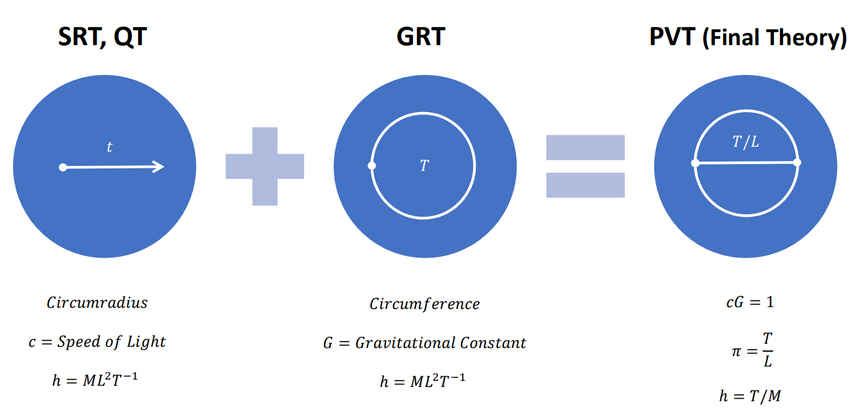
Special relativity (and large parts of quantum theory) treats velocity primarily as linear distance per external time (“Circumradius”) and introduces an external, one-dimensional time parameter t. General relativity supplements this with the dynamic curvature of spacetime, thereby addressing the “Circumference”. The PVT recognizes both as projections of one and the same underlying geometric relation: the internal angular curvature of a volume, expressed by π = T/L.
From this it follows directly that c and G are not independent universal constants but are linked by a rational relation (cG = 1 in appropriate normalization). Time is no longer an external parameter but internal curvature within a 6-dimensional volume ontology (3 lengths + 3 angles).
Q: How does the PVT differ from other well-known approaches to quantum gravity?
A: Most established programs (string theory/M-theory, loop quantum gravity, asymptotic safety, causal dynamical triangulations, Wolfram Physics Project, Geometric Unity, etc.) as well as the multitude of independent “Theory of Everything” proposals share a common characteristic: they build upon the axioms of standard physics and attempt to extend or reinterpret them.
A systematic comparison is given in the following table:
| Approach / Category | Treatment of Time | Natural Constants | Origin and Meaning of Planck Units | Handling of QT–GRT Incompatibility | Relation to PVT |
|---|---|---|---|---|---|
| String Theory / M-Theory | External parameter | Free parameters | String length as fundamental scale | Different background geometries | Builds on standard axioms |
| Loop Quantum Gravity (LQG) | Emergent from spin networks, externally calibrated | G and ħ as input | Discrete areas/volumes (numerical) | Discretization without full time consistency | Recognizes the problem of time but does not solve it axiomatically |
| Wolfram Physics Project | Emergent as hypergraph updates | Emergent from rules | Scale of hypergraph elements | Different levels of emergence | Algorithmic, no correction of measurement ontology |
| Geometric Unity (Weinstein) | Embedded in higher-dimensional manifold | Geometrically motivated, speculative | Part of higher geometry | 4D vs. 14D structure | Speculative |
| Asymptotic Safety, CDT, etc. | Mostly external or weakly emergent | Input or renormalization artifacts | Fixed-point scales or lattice spacings | Renormalizability or discretization | Technically interesting but axiomatically based on standard physics |
| Independent ToE proposals (viXra, etc.) | Often external time or ad-hoc definitions | Frequently new dimensionless numbers | Rarely treated systematically | Mostly superficial or ignored | Usually speculative extensions |
| Panvitalistic Theory (PVT) | Internal angular curvature π = T/L | Calibration artifacts of the dual time definition | Reduction to the geometric relation π = circumference / diameter (internal curvature of a 6D volume); follows from correction of the dimension of h (T⁴/L⁴ instead of ML²T⁻¹) | Direct consequence of the historical category mistake in the definition of time | 6D volume ontology with rational comparisons (V_A = x V_B, x ∈ ℚ); dynamical formalism (constraint δV = 0) still under development |
Q: One aspect that sets the PVT apart is its treatment of infinity. Could you elaborate?
A: This is indeed a central distinguishing feature. In all other approaches, the concept of actual infinity enters physics in two fundamental ways:
- Through the use of π as a dimensionless irrational number. As shown in the paper “The Categorical Fallacy of π”, any equation that equates a finite, measurable quantity (e.g., circumference = 2πr) with an infinite algorithmic process renders the underlying mathematics incomplete and undecidable in the sense of Gödel. This introduces an intrinsic indeterminism that is not a property of nature but an artifact of inconsistent mathematics.
- Through the assumption of an external, independent time parameter. While spatial distance always starts at zero and can only theoretically tend toward infinity, external time necessarily extends into the past from −∞, because the past is assumed to be already existent. This tacitly treats “infinity” as a realized physical quantity.
The PVT eliminates both sources of actual infinity by assigning dimension to π (π = T/L) and by replacing external time with internal angular curvature. Infinity is thereby relegated to a purely potential concept (a limit of rational approximations) and no longer appears as an actually realized physical entity. In this sense the PVT is the only currently known framework that consistently excludes actual infinity from its foundational ontology.
Q: The PVT is occasionally described as an “intellectual liberation”. In what sense?
A: By returning to a strictly dimensioned and measurement-based ontology, the PVT reduces several counter-intuitive claims of standard physics to transparent geometric relations:
- The universal speed limit becomes a projection of the areal-velocity definition of c.
- The linkage of space and external time, as well as the curvature of spacetime as an independent dynamical entity, are shown to be unnecessary once lengths and angles are treated as inherently connected.
- Dimensionless fundamental constants are recognized as consequences of historical scaling choices rather than intrinsic properties of nature.
- The Planck units, regarded in standard physics as the scale where known physics breaks down, reduce to artifacts of the incorrect dimensional assignment of Planck’s constant. In the PVT framework the Planck mass becomes a multiple of π and the Planck length π⁴ — a direct logical consequence of the corrected dimensions. Either this dimensional correction is valid, in which case the reduced Planck units follow consistently, or the entire PVT is incorrect.
- The apparent indeterminism of quantum theory is traced to the introduction of a principally unmeasurable external time parameter. A model containing a non-measurable parameter is necessarily indeterminate, independent of the actual nature of reality.
Q: Is the PVT therefore already a completed final theory?
A: No. The PVT provides a coherent axiomatic foundation whose ontological and measurement-theoretical consequences are largely elaborated. The dynamical formalism — in particular the constraint δV = 0 and the derived equations of motion — is still under active development. Its present strength lies in the consistent resolution of long-standing conceptual inconsistencies and in the elimination of numerous ad-hoc assumptions of standard physics (singularities, dark energy/matter as independent entities, indeterminism as a fundamental principle).
Whether the PVT will ultimately serve as a stable axiomatic framework capable of enduring over time will depend on further mathematical elaboration, the derivation of concrete testable predictions, and their experimental verification. At present, however, it offers the most parsimonious and ontologically consistent alternative by addressing the identified problems at their axiomatic root.