 View / Download Full Paper on Zenodo
Abstract
Einstein's 1905 paper introduced the Special Theory of Relativity by postulating $c = L/T = \text{constant}$. This paper re-examines the foundational assumptions from the Panvitalistic Theory (PVT) perspective.
We show that Einstein treated velocity as a one-dimensional linear quantity, thereby necessitating the introduction of a second, external time parameter. In the PVT, $v = L/T$ is recognized as an inherently two-dimensional areal quantity, where $T$ is internal angular curvature. Replacing the postulate $c = L/T = \text{constant} > 0$ with the geometrically derived axiom $\pi = T/L = \text{constant} > 0$ eliminates the need for external time.
The Lorentz transformation is revealed as a mathematical projection artifact of the deeper 6D areal geometry onto a 4D spacetime with external time. The central insight of special relativity — “the shortest path from A to B is a straight line” — is preserved, but now grounded in a consistent geometric ontology without external time.
1. Introduction
In his 1905 paper “On the Electrodynamics of Moving Bodies”, Albert Einstein made two postulates and derived the Lorentz transformation. The work is rightly celebrated for reconciling Maxwell's electrodynamics with the principle of relativity.
However, a deeper analysis reveals a subtle but profound ontological assumption. Einstein modeled velocity as a linear, one-dimensional quantity $v = L/t$, where $t$ is external time. This modeling choice — drawing a straight line on paper and labeling it $v = L/T$ — treated a fundamentally two-dimensional geometric relation (distance plus curvature) as if it were one-dimensional. To make this model consistent, he was forced to introduce a second, external time parameter.
The Panvitalistic Theory offers a more consistent alternative by recognizing from the outset what time and velocity actually are in a measurement-based sense.
2. Einstein's Postulate and Its Implicit Modeling Choice
Einstein's second postulate states that the speed of light is constant:
$c = \frac{L}{t} = \text{constant} > 0$
This postulate introduces a specific positive number as a fundamental limit. When considering two inertial frames in relative motion with velocity $v$, the classical expectation for the speed of light becomes $c \pm v$. To enforce constancy of $c$, Einstein modifies the coordinate transformations, leading to the Lorentz factor containing the quadratic term $v^2/c^2$.
The crucial point is this: Einstein drew a straight line on paper and called it velocity $v = L/T$. A straight line is geometrically one-dimensional. A curved path, however, is inherently two-dimensional — it possesses both extent (L) and curvature. By modeling velocity as a line, Einstein was forced to introduce an additional, external time dimension to compensate for the missing second dimension (curvature).
In other words, he did not replace absolute time with relative time. He kept an absolute time parameter (external coordinate time) and added a relative component. This second time was a mathematical construct introduced because the underlying geometric model was incomplete.
3. The Panvitalistic Alternative: Velocity as Areal Quantity
In the Panvitalistic Theory, time is not an external parameter but internal angular curvature $T$, governed by the axiom
$\pi = \frac{T}{L}$
In the PVT, $v = L/T$ is an areal quantity: it represents the ratio of the straight-line separation $L$ to the internal angular curvature $T$. Geometrically, it corresponds to the area between the ideal straight path and the actual curved path connecting two points.
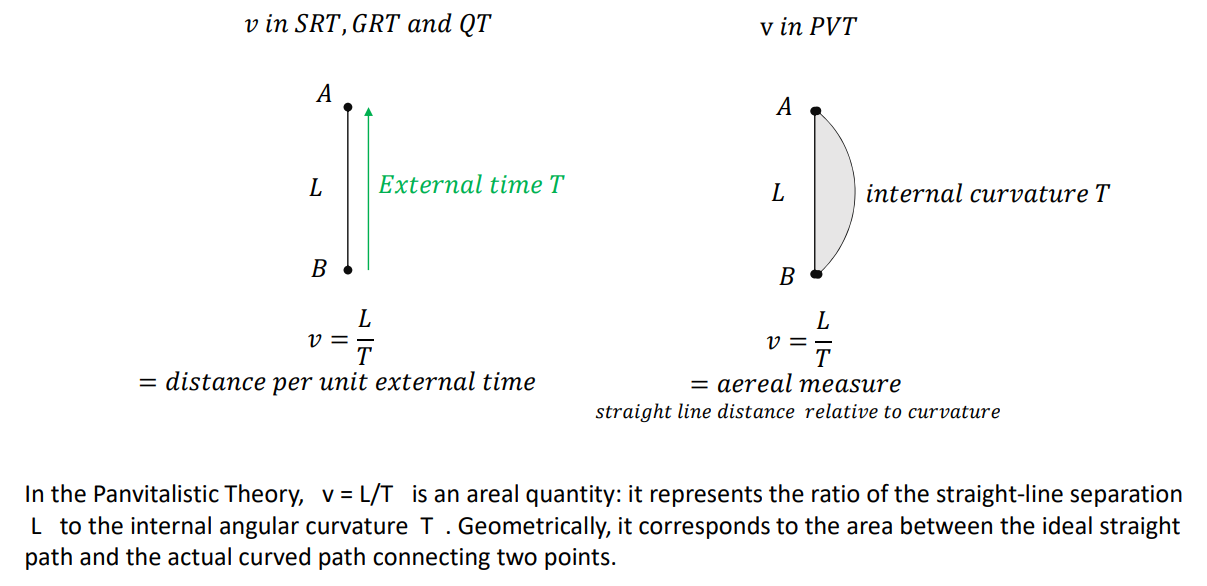
When we normalize the straight-line distance to $L = 1$, $v = 1/T$. Since curvature $T$ ranges from 0 (perfect straightness) to a maximum value (e.g. π for a semicircle), $v$ ranges from a minimum (maximum curvature) to +∞ (as $T \to 0$).
Thus, in the PVT there is no upper speed limit. There is only a maximum straightness. The apparent speed limit $c$ in the 4D projection is simply the manifestation of perfect straightness ($T \to 0$).
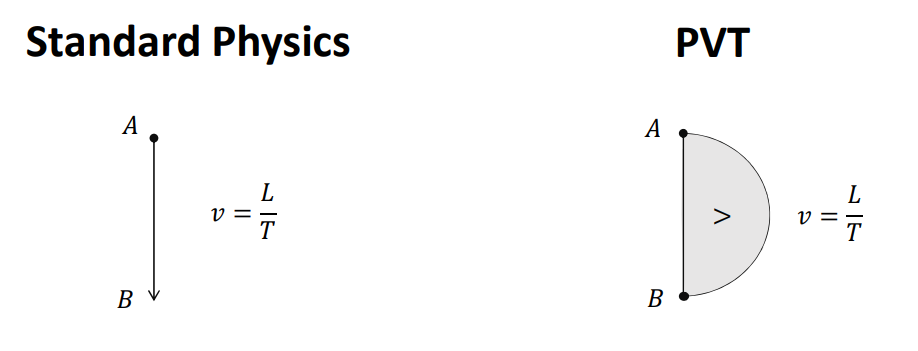
This single shift — recognizing $L/T$ as inherently two-dimensional from the beginning — removes the necessity for an external time parameter.
4. Geometric Unification of $c$ and $G$: The Hidden Scaling Introduced in 1795
The historical definitions of the SI units already encode the deep connection between $c$ and $G$. The meter and second were chosen such that the equatorial rotation of the Earth yields
$c = \frac{D_{\rm Equator}^2}{2\pi \cdot 86400\,\text{s}} \sim \frac{L^2}{T}$
an areal velocity. The kilogram was defined as the mass of 1 000 cm³ (= 10⁻³ m³) of water, measured at the temperature of maximum density on the Earth's surface — i.e., at the equatorial radius fixed by the above definition of $c$. Thus mass is tied to a volume ($L^3$) while $c$ is tied to an area ($L^2$) generated from the same rotating Earth.
4.1 The Two Extreme Round-Trips
Consider the same two points A and B. We compare the two extreme ways to travel from A to B and back to A:
- Shortest round-trip (straight-line limit): Travel from A to B along the straight line and return along the same line. The total reference length is ABA = 2. Curvature T → 0. This is the limiting case of perfect straightness, corresponding to the constant c.
- Longest sensible round-trip (full circular closure): Travel from A to B along a semicircle and continue along the second semicircle back to A, forming a complete circle with diameter AB = 2R. This closed orbit corresponds to the gravitational interaction governed by G.
The geometric factor of 2 arises directly from comparing the straight round-trip length (ABA = 2) with the full circumference (2πR). Because velocity is inherently areal (T/L ≡ L²), we apply the linear scaling factor 10 derived from the kilogram definition. With π ≈ 1 this yields L² = 100 for the gravitational side. Combining the geometric factor 2 with this areal scaling produces the observed relation:
$cG = \frac{2}{100} \quad \Leftrightarrow \quad \frac{100}{2} cG = 1$
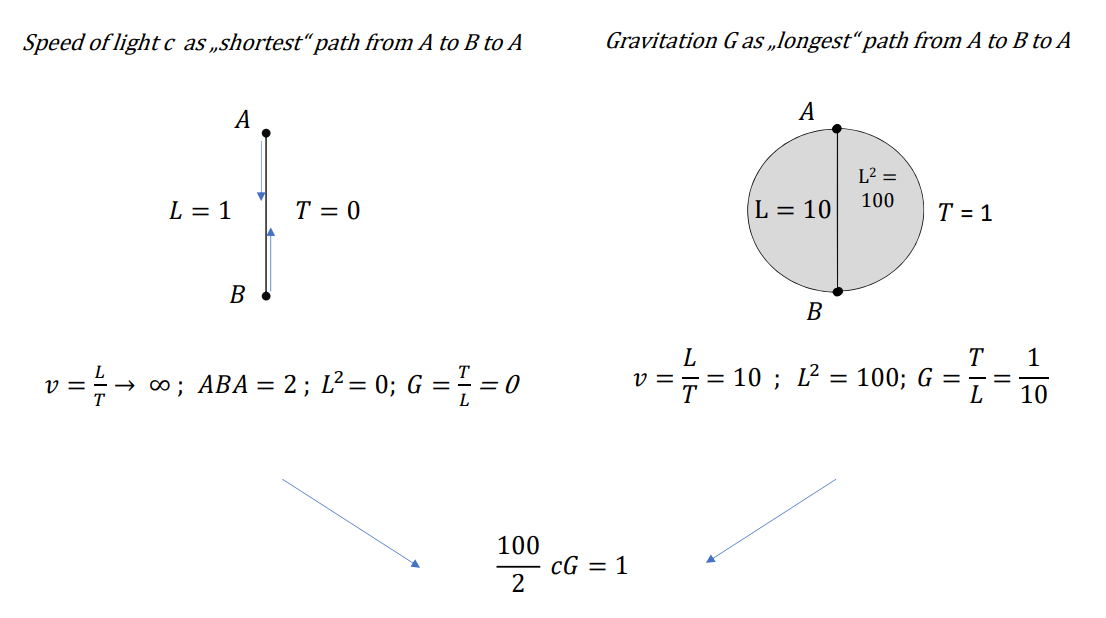
This unification reveals that c and G are not independent constants but two different scalings of the same underlying geometry.
5. Mathematical Derivation: How the Lorentz Transformation Emerges as a Projection
We now show rigorously how the Lorentz transformation arises when the areal geometry of the PVT is projected onto a 4D spacetime with external time.
Let two events A and B be separated by straight-line distance L. In the full 6D geometry, the connection is characterized by internal curvature T. The areal quantity is
$v_{\rm PVT} = \frac{L}{T}$
When this geometry is projected onto external time coordinates, the observed velocity becomes
$v = \frac{L}{t_{\rm ext}}$
Imposing invariance of the areal quantity L/T under boosts between frames leads directly to the transformation rules that coincide with the Lorentz transformation in the 4D projection:
$x' = \gamma(x - vt), \quad t' = \gamma\left(t - \frac{vx}{c^2}\right)$
with
$\gamma = \frac{1}{\sqrt{1 - v^2/c^2}}$
Thus, the Lorentz transformation is not a fundamental law. It is the mathematical rule that preserves the underlying areal geometry of the PVT when viewed through the distorting lens of external time.
6. Exkurs: Maxwell's Equations and the Emergence of c² under Isotropy
Einstein's 1905 paper explicitly reformulated Maxwell's equations to be consistent with his postulate c = L/T = constant. A central relation in Maxwell's theory is
$\varepsilon_0 \mu_0 c^2 = 1$
which enforces the isotropy of space and the constancy of the speed of light.
From the Panvitalistic perspective, this relation can be understood as the dimensional definition of an isotropic space under the assumption of external time. Isotropy in 6D volume space means that all three angular dimensions are at perfect orthogonality:
$ \frac{T_1}{L_1} = 0, \quad \frac{T_2}{L_2} = 0, \quad \frac{T_3}{L_3} = 0 $
When projected onto a 4D spacetime with external time, this condition of zero curvature in all three angular directions forces the areal character L/T into the quadratic form c².
In the PVT, no such squaring is required. Since v = L/T is already an areal quantity and the fundamental axiom is π = T/L, Maxwell's equations can be reformulated directly as volume balances in 6D space.
7. The Core Category Mistake in Einstein's 1905 Paper: Time Treated as Length
The deepest problem in Einstein's 1905 paper is not merely the introduction of an external time, but the specific geometric quality he assigns to it. In §1, Einstein defines simultaneity through the exchange of light signals and constructs the Lorentz transformation, in which time enters the formalism multiplied by c, yielding the coordinate ct. In effect, Einstein promotes time to the status of a fourth spatial dimension.
This is not merely an ontological overreach. It is a fundamental physical category mistake. In the Panvitalistic Theory, time is never a length. Time is angular curvature — an internal deviation from straightness, strictly bounded between 0 and 1 for any given reference length. It does not possess the property of linear extension that would allow it to be added to the spatial coordinates x, y, z as if it were another distance.
By treating time as a length (ct), Einstein inadvertently doubled the time concept in a dimensional sense. This doubling lies at the root of the incompatibility between quantum theory and general relativity.
8. Conclusion
Einstein introduced the postulate c = L/T = constant > 0 as an ad-hoc assumption to reconcile the Michelson-Morley result with Maxwell's equations. This choice was necessary because he modeled velocity as a one-dimensional linear quantity. By drawing a straight line on paper and labeling it v = L/T, a fundamentally two-dimensional geometric relation (straight-line distance plus curvature) was treated as one-dimensional. To make this model consistent, a second, external time parameter had to be introduced.
The Panvitalistic Theory starts from a deeper and more general axiom: π = T/L = constant, where this constant is in principle scalable from 0 to infinity. Because v = L/T is recognized as an inherently two-dimensional areal quantity from the outset, there is no need for an external time parameter. The case T → 0 (perfect straightness) is naturally included and corresponds to the geometric limit of a straight line.
In this framework, the Lorentz transformation is not a fundamental law of nature, but a mathematical projection artifact that arises when the 6D areal geometry of the PVT is viewed through the lens of an external time coordinate. The central insight of special relativity — “the shortest path from A to B is a straight line” — is preserved, but now grounded in a consistent geometric ontology without requiring a second time.
A central consequence of the PVT is that it eliminates both dimensioned and dimensionless constants in the traditional sense. What remain are only the most fundamental rational numbers: the three angular dimensions, the four right angles in a full circle, and the smallest Pythagorean triple 3-4-5 = 12, which together define the structure of rational volume comparisons VA = x VB with x ∈ ℚ.
The Panvitalistic Theory thus completes what Einstein began: it offers a truly general relativity that no longer requires the introduction of an artificial second time to make the description consistent.
References
[1] M. U. E. Pohl, “Unified Principles of Nature: Solution to the Problem of Time”, Scientific God Journal, 10(3):150–166, 2019.
[2] M. U. E. Pohl, “Unified Principles of Nature: Solution to the Problem of Time II+III”, Scientific God Journal, 11(1):49–74, 2020.
[3] M. U. E. Pohl, “Search for the World Formula”, Scientific God Journal, 13(1):30–72, 2022. https://doi.org/10.5281/zenodo.15616112
[4] M. U. E. Pohl, “Errors in the International System of Units (SI)”, 2022. https://doi.org/10.13140/RG.2.2.13069.00485/1
[5] M. U. E. Pohl, “What is Space Time? A clear solution to Einsteins puzzle”, 2024. https://doi.org/10.13140/RG.2.2.14055.83361
[6] M. U. E. Pohl, “On the Circularity of Physical Units and the Implications for a Unified Theory”, 2025. https://doi.org/10.5281/zenodo.15640261
[7] M. U. E. Pohl, “A Logical Proof of God: The Living Universe as the Necessary Axiom”, 2025. https://doi.org/10.5281/zenodo.16279744
[8] M. U. E. Pohl, “The Panvitalist Theory: An Overview of Its Current Status and Contrasts with Contemporary Physics”, 2025. https://doi.org/10.5281/zenodo.16496227
[9] M. U. E. Pohl, “Why Speed of Light is the Rotational Areal Speed of Planet Earth (L²/T) – A Reinterpretation of the Michelson-Morley Experiment”, 2026. https://doi.org/10.5281/zenodo.18488393
[10] M. U. E. Pohl, “The Categorical Fallacy of π : Re-Founding Science”, 2026. https://doi.org/10.5281/zenodo.18505872
[11] M. U. E. Pohl, “PVT Spacetime Definition: A Rigorous Mathematical Derivation of 12-Dimensional Spacetime”, 2026. https://doi.org/10.5281/zenodo.18833891
[12] M. U. E. Pohl, “Experimental Confirmation of PVT in 5 Minutes: Schwarzschild(radius) to go”, 2026. https://doi.org/10.5281/zenodo.18834011
[13] M. U. E. Pohl, “Mass, Charge and Electric Current as Purely Geometric Projections in the Panvitalistic Theory (PVT)”, 2026. https://doi.org/10.5281/zenodo.18841669
[14] M. U. E. Pohl, “Quantization and Singularities in the Macrocosm: Insights from the Panvitalistic Theory (PVT)”, 2026. https://doi.org/10.5281/zenodo.18841750
[15] M. U. E. Pohl, “Deriving the Canonical Wheeler-DeWitt Equation from the Axioms of the Panvitalistic Theory (PVT): A Discussion of the ADM Formalism in PVT”, 2026. https://doi.org/10.5281/zenodo.18841981